Virginia’s expanded presumptive cancer coverage closes a dangerous gap for firefighters and their families. In 2025, the Commonwealth clarified and expanded presumptive cancer coverage under state workers’ compensation law following the death of Loudoun County Fire Captain Dannie Wilson.
Cancer has become the leading cause of line-of-duty deaths among firefighters nationwide.
According to the International Association of Fire Fighters, cancer caused almost 80% of career firefighter line-of-duty deaths in 2025. Research shows that, when compared to the general population, firefighters face a 9% higher risk of being diagnosed with cancer and a 14% higher risk of dying from it.
Virginia’s reform also reflects broader national trends seen throughout 2025, a year marked by both meaningful progress and persistent gaps in firefighter and EMS protections across the country, as highlighted in the Fire & EMS 2025 Year in Review.
What Changed in Virginia Law
About Presumptive Cancer Coverage
Presumptive coverage laws establish a legal presumption that certain cancers contracted resulted from duty-related exposure to carcinogens. These laws shift the burden of proof away from firefighters and their families, who would otherwise need to demonstrate a direct causal link between their work and their illness. But as chemical exposure is usually cumulative, this is often an impossible task.
Under presumptive coverage, once a firefighter meets specific eligibility criteria, their cancer is presumed to be work-related unless the employer can prove otherwise. In this way, firefighters can access workers’ compensation, expand their medical coverage, and qualify for disability benefits more easily.
Although Virginia already had presumptive coverage laws, its statute contained several critical gaps. Wording errors and a lack of specificity kept it from helping firefighters effectively.
Key Updates in the 2025 Expansion
The new version of the bill, which was passed by the Virginia General Assembly, took effect on July 1, 2025.
The document now defines “throat cancer,” a term not recognized as a standard medical diagnosis, to mean any cancer that forms in the tissues of the pharynx, larynx, adenoid, tonsil, esophagus, trachea, nasopharynx, oropharynx, or hypopharynx. It also explicitly includes esophageal and related cancers as eligible for workers’ compensation coverage.
Finally, it clarifies who is eligible for these benefits: firefighters with at least 5 years of service who have medical examinations showing no evidence of covered cancers before being hired.
The Human Story Behind the Legislation
The Death of Loudoun County Captain Dannie Wilson
Captain Dannie Wilson served the Loudoun County Combined Fire and Rescue System for more than 25 years. In early 2025, he underwent a scan for back pain that unexpectedly revealed esophageal cancer. By the time it was discovered, the cancer had already progressed significantly.
Despite his decades of service and clear occupational exposure to carcinogens, Wilson’s initial claim was denied. These occupational hazards extend beyond fire suppression alone, as firefighters are frequently called upon to respond to civil unrest and other large-scale public emergencies, further compounding exposure risks and long-term health impacts.
The basis? The basis was a statutory gap: Virginia’s law referenced “throat cancer” rather than specific anatomical terms, and it made no explicit mention of the esophagus. This allowed administrators to exclude esophageal cancer from coverage.
Captain Wilson died on August 31, 2025. Because the legislative expansion took effect on July 1, 2025, his death should fall under the new coverage provisions, though his family was still awaiting a final determination at the time on his Virginia Line of Duty Act claim at the time. A line-of-duty designation would provide his family with lifetime healthcare coverage and a $75,000 payment.
Myers reflected on Wilson’s legacy: “Dannie was a great teacher, and he loved his wife and children more than anything else. More needs to be done so something like this doesn’t happen to another family.”
Advocacy That Drove Reform
The gap in Virginia’s law became tragically apparent through Wilson’s case, but advocacy and local action turned tragedy into lasting protection for Virginia firefighters.
The Virginia Professional Fire Fighters led the charge, working closely with state legislators to draft language that would close any existing loopholes.
Loudon’s largest professional firefighters association, the Local 3756, partnered with the Inova Saville Cancer Screening and Prevention Center in Northern Virginia, which has already identified several area firefighter cancer cases. According to Local 3756 President John Myers, “It’s efforts like these, building partnerships and identifying where we’re seeing higher rates of diagnosis, which allow us to take solid data. The gold standard is simple: if you hear the word ‘cancer,’ it should be covered.”
Why Presumptive Cancer Coverage Matters
Occupational Cancer Risks for Firefighters
During fire suppression, firefighters are exposed to a complex mixture of carcinogens, including polycyclic aromatic hydrocarbons, benzene, formaldehyde, diesel exhaust, and countless other toxic substances. A 2017 University of Ottawa study found that firefighters absorbed harmful chemicals through their skin during emergency responses, and some of them could even be found in urine immediately after a fire.
The accumulated exposure over years of service creates elevated cancer risks across multiple body systems. Firefighters face significantly increased risks for testicular cancer, mesothelioma, multiple myeloma, non-Hodgkin’s lymphoma, skin cancer, brain cancer, prostate cancer, and colon cancer, among others.
Financial and Emotional Impact on Families
When a firefighter is diagnosed with cancer, the financial burden can be devastating. Medical treatments are expensive, and many firefighters face reduced income or complete disability during treatment.
Presumptive cancer coverage ensures that workers’ compensation benefits are available to cover medical expenses, provide disability payments, and support families if the firefighter dies from the disease. For families, this can mean the difference between financial stability and ruin during an already traumatic time.
Presumptive coverage exists alongside other efforts to protect firefighter health through prevention and infrastructure investment. Communities such as Albuquerque, where voters approved a fire and EMS bond to improve facilities and operations, show how proactive funding can reduce long-term health and safety risks for first responders.
Beyond financial considerations, presumptive coverage represents recognition and respect for the sacrifices firefighters make in service to their communities.
Broader Trends in Firefighter Health Policy
How Other States Are Responding
All 50 states, the District of Columbia, and federal firefighters now have some form of presumptive coverage legislation. However, coverage varies widely across jurisdictions in terms of which cancers are covered, eligibility requirements, and the strength of the presumption.
States like Colorado have moved toward comprehensive cancer programs, while others continue to expand their lists of covered cancers based on emerging research. Many states require minimum service periods ranging from three to ten years, tobacco-free certifications, and baseline medical examinations.
Federal Context and Future Policy
At the federal level, Congress recently passed the Honoring Our Fallen Heroes Act, which recognizes 20 different types of cancers as line-of-duty deaths under the Public Safety Officers’ Benefits program. This will apply to any firefighters with at least five years of service who are diagnosed within 15 years of their last service date.
These federal protections complement state-level workers’ compensation programs. They display a growing recognition of cancer as a national occupational health crisis among firefighters.
What This Means for Firefighters and Communities
Virginia’s 2025 expansion delivers concrete benefits to firefighters and their families. The clarified language eliminates an ambiguity that was resulting in denied claims.
These protections also send an important message about the value communities place on firefighter health and safety. In turn, this can improve recruitment and retention, as it shows fire departments and state governments take their obligation to protect those who protect the public seriously.
Final Thoughts
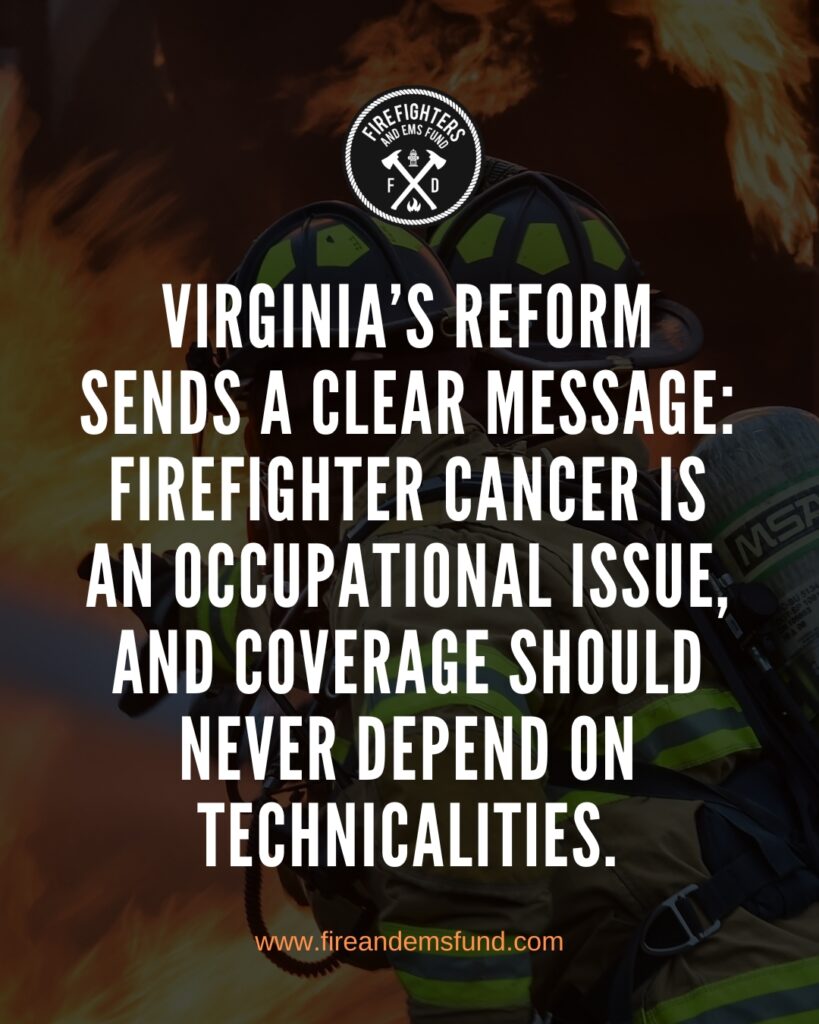
Virginia’s expansion of presumptive cancer coverage marks a significant step forward in firefighter health protection. The reform emerged from the intersection of scientific evidence, persistent advocacy, and the painful reality of Captain Dannie Wilson’s experience.
The role of advocacy, data, and lived experience in shaping this policy cannot be overstated. As states build on reforms like Virginia’s, these issues will continue to shape conversations as policymakers and advocates look ahead to the fire and EMS challenges of 2026. To achieve reform, organizations like the IAFF affiliates partnered with medical researchers, documented cancer cases, and collaborated with legislators to craft precise, comprehensive statutory language.
Yet Virginia’s achievement is not the end of the story. Continued reform remains essential to protect first responders nationwide. The goal, as Myers articulated, is simple but profound: “If you hear the word ‘cancer,’ it should be covered.”