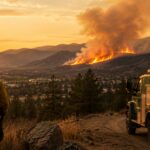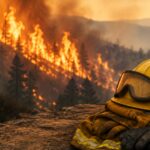

New details continue to emerge about the wildfire tragedy that claimed three wildland firefighters’ lives in western Colorado in late June. The incident, centered on the Knowles Fire near the Colorado-Utah border, has become one of the deadliest U.S. wildfire burnovers in more than a decade. As investigators reconstruct what happened, it is already offering critical lessons for wildfire operations, firefighter safety, and emergency planning nationwide.
What Happened?
On June 27, members of the Rifle Helitack crew, firefighters with the U.S. Forest Service, and the newly formed U.S. Wildland Fire Service were conducting initial attack operations on the Knowles Fire in western Colorado.
As fast-moving flames cut off their escape routes, the crew deployed emergency fire shelters, a last-resort protective measure. Three firefighters, Emily Barker, 38, Nick Hutcherson, 27, and Sydney Watson, 27, died in the burnover. Two other crew members were injured and received medical care.
The Knowles Fire later merged with nearby fires and is now managed collectively as the Snyder Fire, which burned more than 28,000 acres and remains at zero percent containment. The tragedy marked the first line-of-duty deaths for the U.S. Wildland Fire Service, drawing national attention to the risks facing wildland firefighters.
What Is a Wildfire Burnover?
A burnover occurs when firefighters are overtaken by flames faster than they can retreat, forcing them into a last line of defense: deploying foil-lined, heat-resistant fire shelters.
Because these shelters are not designed to withstand direct flame contact, burnovers rank among the most dangerous scenarios in wildland firefighting. Common contributing factors include sudden shifts in wind direction, extreme and unpredictable fire behavior, difficult terrain, limited or blocked escape routes, and rapidly changing weather, any of which can turn a manageable fire into a life-threatening situation within minutes.
What the Investigation Has Revealed So Far
A full investigation into the Knowles Fire deaths could take several months, and officials caution that complete answers may remain elusive.
But so far, experts are discussing several possible factors that may have played a role. First, drought conditions and gusty winds reaching up to 60 mph were present in the region at the time, making the fire take unpredictable paths. Utah’s governor noted that firefighters were encountering fire behavior unlike anything they had previously witnessed. This may have made deployment and operational decisions harder and more delicate.
Observers have drawn comparisons to the 2013 Yarnell Hill Fire, where investigators similarly struggled to reconstruct radio communications and decision-making in the fire’s final minutes. That investigation ultimately found the firefighters had followed standards and guidelines, and that commanders made reasonable judgments amid rapidly worsening conditions.
Why This Incident Matters Beyond Colorado
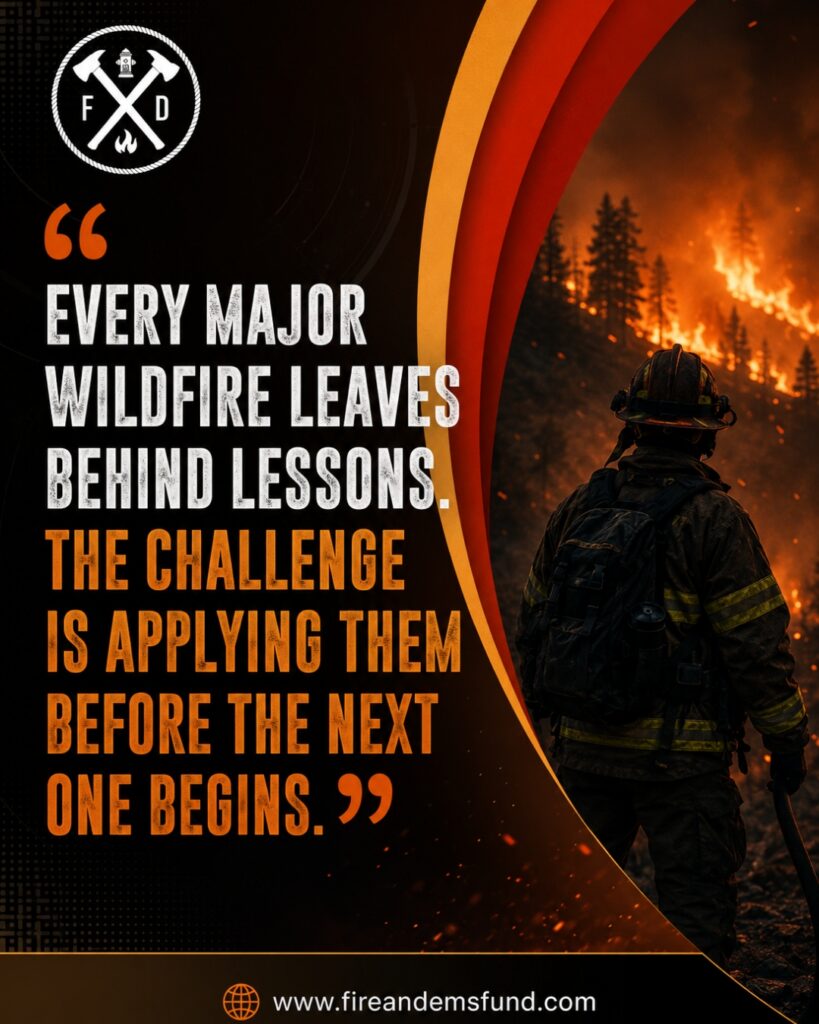
The Knowles Fire tragedy reflects broader trends reshaping wildland firefighting nationwide, including increasingly intense and unpredictable fire behavior, longer fire seasons and growing operational complexity.
While overall wildfire frequency has declined over the past decade, wildland firefighter deaths as a share of all firefighting fatalities have risen sharply, from roughly 2 percent to 10 percent.
Similar risk factors exist across much of the drought-prone West and beyond. In addition, in
Lessons for Fire Departments and Emergency Services
The incident underscores several areas in need of change.
Training should continue to reinforce wildfire behavior recognition and rapid decision-making. In this sense, LCES principles (Lookouts, Communications, Escape Routes, Safety Zones) should be disseminated more widely, and clear communication protocols should be established.
Resource management issues remain a widespread concern. This involves ensuring stations are adequately staffed and have access to the equipment they need. In large disasters, access to aviation support and coordinated command structures can make or break the operation, particularly for helitack crews in remote terrain with limited backup.
Ensuring departments have the resources to prepare for increasingly complex emergencies also depends on sustainable funding, an issue highlighted by the recent Wisconsin fire and EMS referendum results.
Community-level preparedness matters too: defensible space, rehearsed evacuation plans, and early warning systems reduce risk for residents and firefighters alike. Similar conversations are taking place in Oregon, where several fire district levies seek funding to strengthen staffing, emergency response, and wildfire preparedness
Key Takeaways
When examining many recent emergencies, commonalities become easier to spot:
- Wildfires Are Becoming More Complex: Fire behavior continues evolving faster than historical planning assumptions. Data gathered from recent blazes needs to be incorporated into weather prediction models and zoning laws.
- Situational Awareness Saves Lives: Rapidly changing conditions require continuous reassessment, which then needs to be communicated quickly.
- Training Must Continue to Evolve: Given the rapidly changing landscape, departments should adapt lessons learned into future operations.
- Community Preparedness Matters Too: Wildfire Resilience Depends on Both Emergency Responders and Residents.
Conclusion
The loss of Emily Barker, Nick Hutcherson, and Sydney Watson is a reminder that wildland firefighting carries extraordinary risk, particularly as fire behavior grows more volatile. Continued investment in training, staffing, equipment, and operational planning is essential to protecting those who respond to these fires. As investigators work to understand what happened on the Knowles Fire, the wildland fire community’s task is to translate hard lessons into safer operations going forward.